

Southern California businesses are shifting from reactive security measures to proactive, intelligent ecosystems that anticipate threats before they escalate. Outdated lock-and-key methods create inefficiencies and risks that slow operations in an economy where accountability and agility are critical.
Access control systems in Southern California serve as the digital backbone of facility management, connecting people, credentials, and infrastructure. Upgrading to advanced, integrated access control is an operational strategy that drives efficiency and increases security across enterprises, campuses, and commercial properties.
The Evolution of Commercial Access Control
Access control technology has evolved from mechanical brass keys to digital credentials that serve commercial, educational, healthcare, and industrial applications across Southern California. Traditional lock-and-key systems offered no accountability, could not scale across multiple sites, and incurred mounting re-keying costs whenever an employee left or keys were lost.
Today’s systems feature the following:
- OSDP-encrypted smart credentials provide secure, tamper-resistant communication between readers and controllers, eliminating vulnerabilities associated with older key card systems for business.
- Cloud-based access control for businesses allows facility managers to unlock doors remotely from smartphones.
- Mobile credentials eliminate the need for physical cards, allowing employees to access facilities using phones or smartwatches equipped with Bluetooth low energy (BLE) or near field communication (NFC) technology.
- Biometric access control for enterprises using facial recognition or fingerprint authentication ensures zero-trust security, where credentials cannot be shared or stolen.
- Multi-factor authentication combines credentials such as a card plus PIN, or mobile and biometric, for high-security zones.
How Enterprise Access Control Systems Maximize Security
Advanced access control delivers layered security by controlling who can enter facilities at what times and which areas they can access. Integration with video surveillance and alarm systems creates unified defense across Southern California organizations.
Granular Control
Role-based access control assigns permissions by job function, department, or clearance level. Organizations can restrict access to sensitive areas, such as server rooms, labs, and executive offices, while allowing free movement in common areas.
Time-based schedules automatically grant or revoke access during business hours, weekends, and holidays. Temporary credentials for contractors expire automatically without manual intervention.
Audit Trails
Every door event, including entries, exits, and denied access attempts, is logged with timestamps and user identification, creating tamper-proof records that meet regulatory requirements. Centralized dashboards provide live visibility across all sites, while searchable audit logs support investigations, HR incidents, and compliance audits.
Pre-built compliance reports simplify regulatory reviews by generating documentation that demonstrates adherence to security standards. Role-based access to logs ensures only authorized personnel view sensitive data. Integration with Security Information and Event Management (SIEM) systems enables unified security monitoring across physical and digital domains.
Remote Management
Cloud dashboards manage doors across multiple sites from a single interface, enabling security teams to efficiently oversee distributed operations. Remote door unlock capabilities accommodate deliveries, after-hours access, or emergency situations without requiring on-site personnel.
Real-time health monitoring alerts administrators to offline readers or connectivity issues before they impact operations. Firmware updates and configuration changes are deployed centrally across all locations, supporting distributed teams managing multiple campuses, warehouses, or branch offices.
University access control systems benefit from remote management during campus-wide emergencies when instant lockdown capabilities across hundreds of doors become critical for student and staff safety.
Integration With Other Security Systems
The Department of Homeland Security’s Video Security Systems Technology Handbook emphasizes the importance of integrated systems for comprehensive facility protection.
Physical access control systems integrate with intrusion alarms to enable end-to-end incident response. A forced door instantly triggers a camera pop-up and sends alerts to security teams. Single interfaces for monitoring doors, cameras, and alarms improve investigation speed.
API integrations connect access control with IT systems to automate user provisioning and keep credentials up to date as organizational changes occur. Visitor management systems integrate to screen guests, issue temporary digital badges, and maintain watchlist screening that flags individuals with security concerns.
Operational Benefits of Access Control
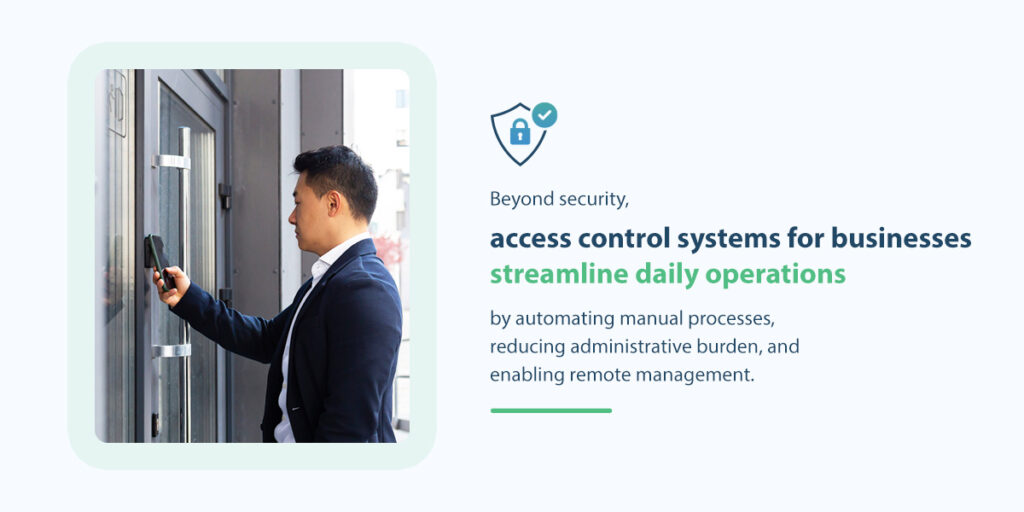
Beyond security, access control systems for businesses streamline daily operations by automating manual processes, reducing administrative burden, and enabling remote management.
Improved Efficiency
Human Resources Information System (HRIS) integration enables employee access management by synchronizing access rights with employee life cycle events.
Modern access control solutions enable the following:
- Automated credential distribution that eliminates delays in providing new employee access
- Instant permission updates when employees change roles or departments
- Centralized management of access across multiple locations from a single dashboard
- Preregistration workflows that allow hosts to approve visitors before arrival
- Contractor scheduling that provides recurring access without daily manual check-ins
Reduced Administrative Burden
Automated access control reduces the need for reception desk staff at every entrance, allowing organizations to reallocate personnel to higher-value tasks. Visitor management automation frees front desk staff from manual badge printing and logging, while audit trails replace manual sign-in sheets and provide superior accountability.
Role-based access control allows security teams to focus on exceptions rather than routine access requests, improving operational efficiency while reducing administrative burden. Remote door unlock eliminates after-hours guard callouts for deliveries or late employees, reducing overtime expenses.
Enhanced Employee Safety
Access control integration with emergency notification systems accelerates incident response by coordinating physical access restrictions with communications during critical events. University and K-12 school access control systems initiate instant campus-wide lockdowns that protect students and staff when threats emerge.
Restricted access to hazardous areas, including manufacturing floors, chemical storage, and electrical rooms, protects workers by ensuring only trained personnel enter high-risk zones. Real-time monitoring identifies individuals attempting unauthorized access to restricted areas, enabling intervention before safety incidents occur.
The ROI of Tailored Access Control for Businesses
Investing in access control delivers measurable returns through cost avoidance, operational savings, and liability reduction. Consider the following:
- Eliminating re-keying: Organizations eliminate lost productivity waiting for locksmiths while avoiding the need for key tracking systems and inventories. Instant credential revocation eliminates security exposure windows. Systems scale to hundreds of doors without linear cost increases.
- Reducing security guard costs: Automated access control reduces the need for reception desk staff at every entrance. Remote door unlock eliminates after-hours guard callouts. Visitor management automation frees front desk staff from manual badge printing.
- Preventing theft: Real-time alerts and audit trails deter internal theft by increasing accountability. Restricted access to inventory and sensitive data areas reduces the risk of loss. Video integration provides evidence for theft investigations. After-hours access monitoring identifies suspicious behavior before incidents occur.
How WCC Technologies Group Implements Advanced Access Control Systems
The right access control system installation requires evaluating system capabilities and understanding facility requirements. WCC Technologies Group provides a structured access control installation process that ensures systems meet both immediate security needs and long-term scalability requirements.
Site Audit and Design
We begin with comprehensive site audits to identify security vulnerabilities and determine optimal placement for readers, controllers, and integration points. The audit includes documenting door schedules, analyzing traffic patterns, assessing cabling requirements, reviewing compliance needs, and developing reference designs that balance security effectiveness with operational workflows.
Technology Selection
Vendor-agnostic architecture prevents lock-in and allows hardware flexibility as technology evolves. Our team matches credential options, including mobile, biometric, smart cards, and PIN codes, to facility security profiles and user preferences. We evaluate cloud-based versus on-premise deployment models based on data control requirements, network infrastructure, and multisite management needs.
Professional Installation
Our end-to-end delivery handles infrastructure, including conduit, structured cabling, and electrical power, alongside:
- Controllers.
- Readers.
- Panels.
- Network integration.
Certified technicians optimize device placement, wiring, and configuration to meet manufacturer specifications and local building codes. Electrified locks, strikes, and maglocks are installed with proper coordination with door hardware.
Programming and testing verify all access rules, schedules, permissions, and integrations function correctly before handoff. As-built documentation, labeling, and clean cable management simplify future maintenance and system modifications.
Training and Support
Our team provides administrator training that covers system operation, user management, report generation, and troubleshooting procedures. Training materials and operational playbooks ensure facility teams can manage daily operations without constant vendor assistance. Ongoing maintenance agreements provide health monitoring, firmware life cycle management, priority support, and rapid response to system issues that keep access control reliable long-term.
Partner With WCC Technologies Group for Advanced Access Control Systems in Southern California
WCC Technologies Group brings over 20 years of Southern California expertise in designing, installing, and supporting access control solutions tailored to your facility’s unique requirements. Our turnkey delivery handles the entire project from infrastructure to training, eliminating contractor coordination headaches. With vendor-agnostic architecture and customer-first designs, we ensure your system fits your workflows today and adapts as your business grows.
Contact us today online or call us at 909-364-9906 to request a quote.