

Southern California businesses depend on fast, secure Wi-Fi for productivity, communication, and client service. Weak infrastructure, outdated cabling, poor design, and network congestion create problems that cost businesses far more than inconvenience.
Network downtime can lead to substantial financial losses and significant disruption for businesses. Beyond monetary costs, unreliable connectivity also negatively impacts teams and client relations. Explore common causes of Wi-Fi failures and how professional networking solutions help eliminate these problems.
The Cost of Unreliable Wi-Fi for Southern California Businesses
Network downtime does not just frustrate employees or disrupt an hour of work. It affects revenue, customer relationships, and competitive positioning in ways many organizations fail to recognize until problems become critical.
Decrease in Productivity
When your wireless network fails, business operations halt. Employees lose access to cloud applications, email, and collaboration tools that are essential to daily work. Video conferences drop mid-meeting, disrupting client presentations and internal communications. The ripple effect of connectivity issues compounds over time, affecting quarterly performance and long-term growth.
Lost Revenue
The financial impact of unreliable Wi-Fi extends beyond the immediate hour of downtime. Delayed transactions result in missed sales opportunities. When teams cannot access files or coordinate effectively due to poor internet connectivity, projects fall behind, and the company loses money over time.
Reputation Damage
Your customers expect seamless connectivity whether they are completing purchases, accessing services, or using guest Wi-Fi in your facility. Frustrated clients unable to complete transactions take their business elsewhere. Poor guest Wi-Fi experiences in hospitality and retail settings damage your brand reputation and diminish the customer experience you work hard to create.
Common Causes of Poor Wi-Fi Performance
Most connectivity problems stem from preventable infrastructure issues, inadequate planning, or outdated equipment struggling to meet modern demands.
Weak Infrastructure and Outdated Cabling
Many businesses blame their internet service provider when Wi-Fi performance suffers, but the real culprit is often the infrastructure behind the wireless network, such as:
- Old category 5 enhanced (Cat5e) cabling or damaged cables that create bottlenecks, limiting the bandwidth available to wireless access points.
- An insufficient fiber-optic backbone capacity that limits data flow, even with high-speed internet service.
Legacy cabling systems installed years ago cannot handle the bandwidth demands of modern cloud applications, video streaming, and high-definition conferencing.
Poor Network Design
Common network design issues include:
- Dead zones: Access points placed without proper site surveys create dead zones throughout facilities. Warehouses, multi-story office buildings, and spaces with complex layouts suffer from coverage gaps that leave entire areas without reliable connectivity.
- Interference: Poor channel planning causes access points to overlap and interfere with each other rather than working together to provide seamless connectivity. One-size-fits-all approaches ignore the unique characteristics of each facility, resulting in inadequate coverage.
Environmental Factors
Radio frequency (RF) interference from neighboring networks degrades signal quality and reduces available bandwidth. Microwave ovens, other electronics, and overlapping channels from nearby businesses create constant interference that slows performance and causes dropped connections.
In Southern California, power outages and connectivity disruptions present ongoing challenges. Wildfires and grid issues interrupt service when businesses need connectivity.
Building-specific challenges compound these problems. Thick concrete and steel walls in urban construction can block wireless signals. Hillside locations and terrain obstacles may also create additional barriers to consistent coverage.
Bandwidth Limitations
The number of connected devices in business environments has exploded. Laptops, smartphones, Internet of Things (IoT) sensors, security cameras, and specialized equipment all compete for bandwidth on the same network. High-density environments like offices, warehouses, and event spaces strain network capacity beyond what older infrastructure can support.
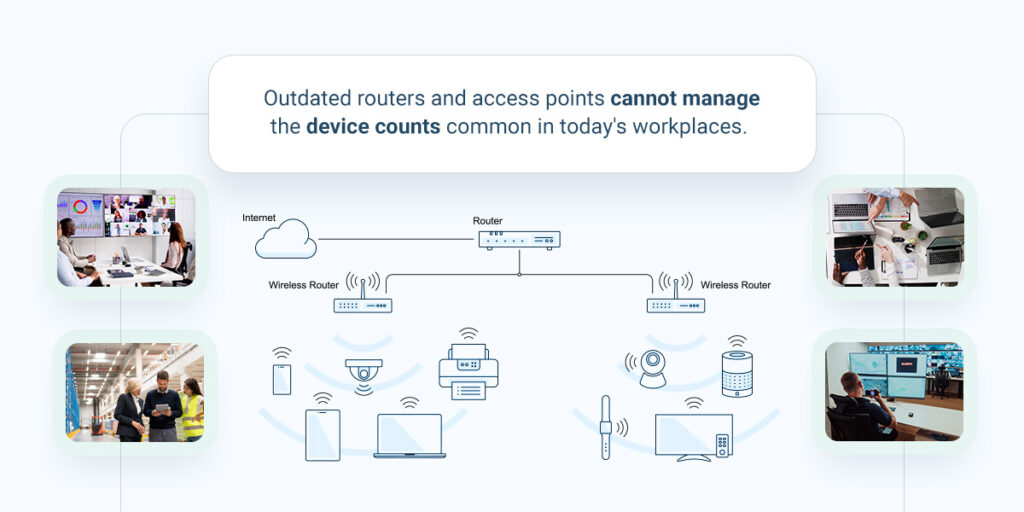
Outdated routers and access points cannot manage the device counts common in today’s workplaces. Bandwidth prioritization issues mean critical business applications compete with nonessential traffic for network resources. Network congestion during peak usage times can also slow performance.
How Professional Networking Solutions Ensure Reliable Wi-Fi
Solving Wi-Fi problems requires more than upgrading routers or adding access points. Professional networking solutions address the root causes through comprehensive planning, proper infrastructure, enterprise-grade equipment, and ongoing management that keeps systems performing at peak levels.
RF Site Surveys and Predictive Heat Mapping
Professional wireless deployments begin with comprehensive site surveys using industry-leading diagnostic tools to identify interference sources and coverage gaps before installation. Predictive modeling shows optimal access point placement based on building layout, construction materials, and anticipated usage patterns. This scientific approach eliminates the guesswork that leads to dead zones and poor performance.
On-site validation testing ensures real-world performance matches design specifications. Technicians verify signal strength, channel assignments, and roaming behavior across the entire facility. This methodology prevents problems rather than reacting to them after installation.
Structured Cabling as the Wireless Foundation
Reliable wireless performance requires a solid wired foundation. Professional structured cabling installations using Cat6, Cat6A, and fiber-optic cables provide the high-speed backbone that wireless access points need to deliver consistent performance. Clean, labeled, and tested cabling eliminates bottlenecks that appear as Wi-Fi problems but actually originate in the wired infrastructure.
Properly designed cabling systems support future bandwidth increases and technology upgrades without requiring complete reinstallation. This forward-looking approach protects your investment and provides the flexibility to scale as business needs evolve.
Enterprise-Grade Access Points and Network Design
Enterprise wireless solutions deliver performance beyond consumer-grade equipment. Technologies like Wi-Fi 6 and Wi-Fi 6E provide significantly higher speeds and better efficiency in environments with many connected devices. Advanced features like adaptive antenna technology and intelligent beamforming dynamically steer wireless signals around interference and obstacles, adapting in real time to maintain stable connections.
High-density WLAN architectures handle hundreds of simultaneous device connections without slowdowns or dropped users. Proper channel planning and roaming optimization ensure devices seamlessly transition between access points as users move throughout facilities. Scalable designs accommodate growth without requiring complete network overhauls.
Ongoing Management and Security
Professional networking solutions include ongoing management and monitoring to maintain peak performance. Proactive maintenance identifies potential issues before they cause outages. Security protocols like WPA3 encryption and 802.1X authentication protect sensitive business data and prevent unauthorized network access.
Network segmentation separates guest, employee, and IoT device traffic for better security and performance management. Regular firmware updates and performance tuning keep systems up to date with the latest security patches and optimization improvements. This continuous oversight ensures networks remain reliable as technology and threats advance.
Partner With WCC Technologies Group for Reliable Wi-Fi
Southern California businesses need wireless infrastructure that is reliable, high-performing, and scalable. WCC Technologies Group delivers end-to-end Wi-Fi solutions for businesses in Los Angeles, Orange County, San Diego, Riverside, and San Bernardino to eliminate dead zones and prevent downtime.
With over 20 years of experience, our design-build approach starts with comprehensive wireless surveys and structured cabling assessments. We deploy enterprise-grade solutions with Wi-Fi 6/6E technology, backed by ongoing networking support, managed services, and 24/7 monitoring.
Contact WCC Technologies Group online or call us at 909-364-9906 to schedule a network assessment.