
Cat6 vs. Cat6A: Which Does Your
Southern California Facility Actually Need?
- The real technical differences between Cat6 and Cat6A
- When Cat6 is still a legitimate choice
- When Cat6A is the right spec — and why it’s more affordable than you think
- The cost question: lifecycle math vs. upfront price
- Shielded vs. unshielded, and what about Cat8?
The Cat6 vs Cat6A decision is one of the first choices you’ll face on any cabling project in Southern California — whether it’s a new build, a tenant improvement, or an infrastructure refresh. It sounds like a minor spec choice. It isn’t. The cable you pull today will be in your walls for 15 to 20 years, and the wrong decision in either direction costs you: underbuild and you’re recabling sooner than you planned; overbuild on a budget that doesn’t justify it and you’ve spent money you didn’t need to.
This post breaks down the real differences between Cat6 and Cat6A, when each is the right answer for Southern California facilities, and what you should be thinking about before you commit to either.
What’s the Actual Difference Between Cat6 and Cat6A?
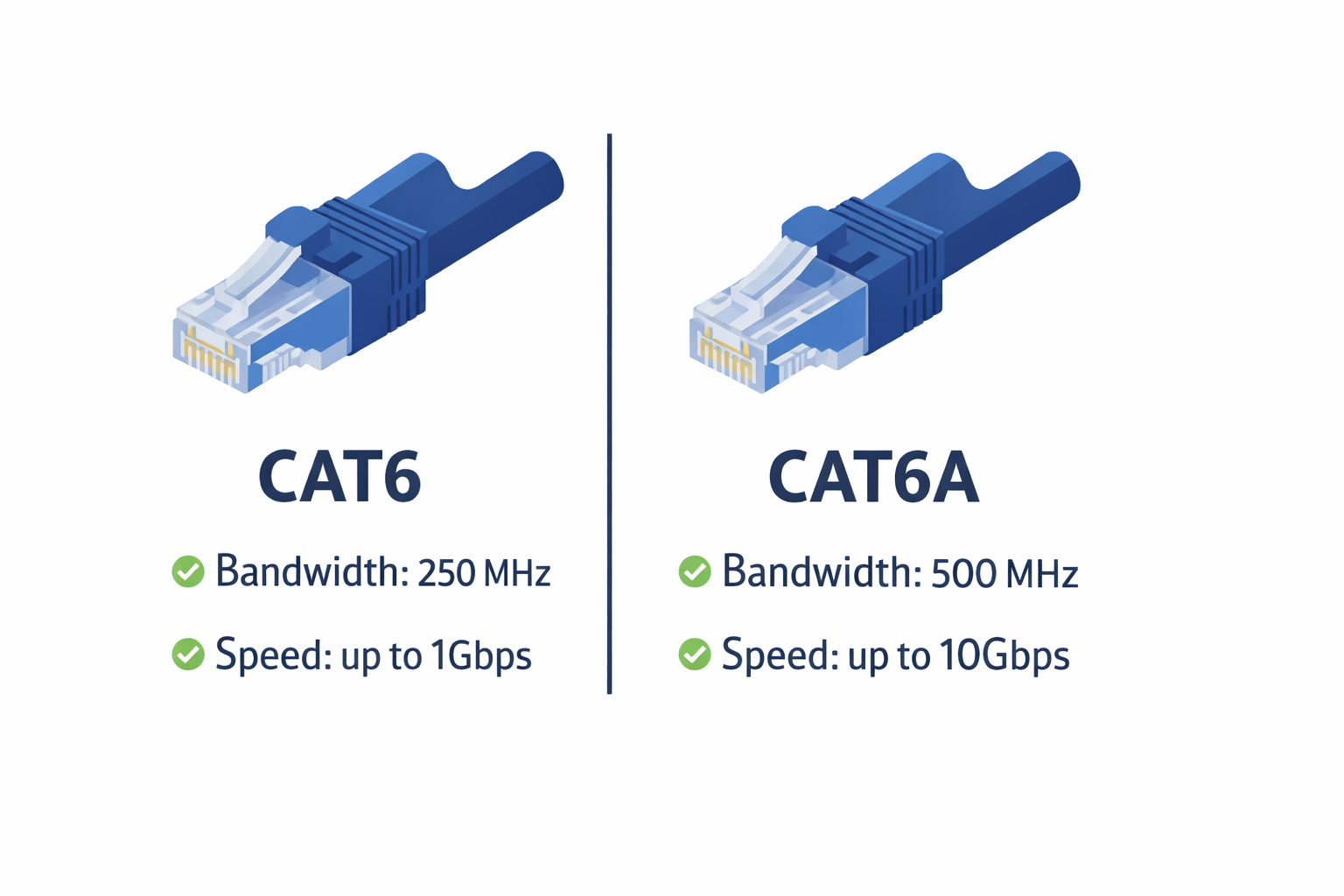
Both Cat6 and Cat6A are twisted-pair copper cabling standards used for structured cabling in commercial environments. The “A” in Cat6A stands for “Augmented” — an enhanced version of Cat6 developed to support faster speeds over longer distances. The practical gap between them isn’t just speed: Cat6A has significantly better alien crosstalk performance, which matters in high-density environments where cables run parallel over long distances.
| Feature | Cat6 | Cat6A |
|---|---|---|
| Max Speed | 1 Gbps (10G under 55m) | 10 Gbps |
| Max Distance at 10G | 55 meters | 100 meters |
| Frequency | 250 MHz | 500 MHz |
| Cable Diameter | Smaller (~6mm) | Larger (~8mm) |
| Alien Crosstalk | Limited protection | Full ANSI/TIA spec protection |
| Material Cost | Lower | 20–40% higher per foot |
| Best For | Short runs, small offices, budget retrofits | New builds, campuses, wireless, healthcare, government |
When Cat6 Is the Right Answer
Cat6 is still a legitimate choice in specific scenarios. Don’t let anyone tell you it’s automatically obsolete — it isn’t.
- Small office environments with short runs. If your longest horizontal run is 40 meters and you’re not planning to push 10 Gbps to the desktop anytime soon, Cat6 does the job at a lower installed cost.
- Budget-constrained retrofit projects. Cat6’s smaller diameter pulls more easily through tight pathways in existing buildings and costs less per foot installed.
- Temporary or transitional spaces. If a space is planned for significant reconfiguration within five years, putting Cat6A in a transitional environment is often hard to justify.
- Low-density deployments. Small retail locations, simple branch offices, and basic warehouse spaces with sparse device counts often don’t need 10 Gbps to every drop.
Key caveat: If there’s any reasonable chance the space will still be in operation in 10 years with meaningfully higher bandwidth demands, the cost delta between Cat6 and Cat6A is usually worth it.
When Cat6A Is the Right Answer
In most commercial environments WCC works in across Southern California, Cat6A is the correct specification. Here’s why.
- You’re running or planning 10 Gbps switching infrastructure. Cat6A is the only copper standard that reliably supports 10 Gbps at 100 meters. If your switching is already 10G or on a realistic upgrade path, your horizontal cabling needs to match.
- High-density wireless deployments. Wi-Fi 6 and Wi-Fi 6E APs commonly support 2.5–5 Gbps uplinks. Running Cat6 to those APs creates a bottleneck at the wall. Cat6A gives you the headroom without recabling later. This is especially relevant when planning your wireless network infrastructure.
- Security camera infrastructure. 4K and 8MP IP cameras — standard across Axis, Avigilon, and Bosch — generate substantial bandwidth per run. Cat6A handles this comfortably in dense camera environments.
- Healthcare, education, and government facilities. Long infrastructure lifecycles and complex compliance requirements mean you rarely get to recable on a convenient schedule. Cat6A from the start avoids costly remediation later.
- Long horizontal runs. On warehouse floors, large school campuses, or multi-story buildings, you’ll regularly approach the 100-meter limit. Cat6A gives you full 10G at that distance. Cat6 doesn’t.
- New construction and major tenant improvements. When walls are open and pathways are accessible, the incremental cost of Cat6A over Cat6 is a small fraction of the total project budget — and you’re paying for the labor to pull cable regardless.
The Cost Question: How Big Is the Gap Really?
This is where a lot of people make the wrong call. They see the per-foot material price difference and assume Cat6A is significantly more expensive. The reality is more nuanced.
Material costs for Cat6A run 20–40% higher per foot than Cat6 — but materials are a fraction of the total installed cost. When you factor in labor, conduit, patch panels, terminations, testing, and documentation, the real per-drop difference is often only 10–20%.
Over a 15-year infrastructure lifecycle, that 10–20% premium looks very different when compared to the cost of pulling cable a second time. Recabling a fully occupied commercial space — furniture moved, ceiling tiles pulled, cable removed and replaced — costs significantly more than getting it right the first time.
Stay with Cat6 or upgrade to Cat6A?
✓ Stay with Cat6 if…
- Runs are under 40 meters
- Space is transitional (<5 years)
- Budget is fixed, scope is small
- Device density is very low
✓ Upgrade to Cat6A if…
- New construction or walls are open
- Runs approach 100 meters
- High-density wireless APs planned
- Healthcare, education, or government
- 10G switching is current or planned
What About Cat8?
Cat8 supports 40 Gbps at distances up to 30 meters — it’s designed for data center backbone runs between switches and servers, not for horizontal structured cabling in office or campus environments. For standard horizontal runs in commercial buildings, Cat8 offers no practical benefit over Cat6A at distances beyond 30 meters and is not the right specification.
Shielded vs. Unshielded: One More Variable
Cat6A comes in unshielded (UTP) and shielded (STP/F/UTP) variants — and this is one more variable worth understanding when making the Cat6 vs Cat6A call in Southern California facilities. Shielded adds electromagnetic interference protection for environments with high EMI exposure — manufacturing floors, facilities near high-voltage equipment, some healthcare environments. For most commercial office, education, and warehouse environments, unshielded Cat6A performs well. Shielded cable requires grounding at both ends and adds termination complexity, so specify it when the environment actually calls for it.
The Bottom Line for Southern California Facilities
For most Southern California facilities, the Cat6 vs Cat6A decision comes down to one question: how long will this infrastructure need to last, and what will you be running on it in five years? If you’re building out a new space, doing a major tenant improvement, or replacing aging infrastructure that will be in service for the next decade, Cat6A is almost always the right specification. The lifecycle math works in its favor, the wireless and switching infrastructure you’ll deploy in the next few years will benefit from it, and the installed cost delta is smaller than most people expect.
If you’re doing a limited retrofit in a budget-constrained environment with short runs and a near-term reconfiguration planned, Cat6 may be the practical answer — but go in with open eyes about what you’re trading away.
The best cabling decision isn’t about the cheapest option today. It’s about the lowest total cost of ownership over the life of the infrastructure.
WCC Technologies Group installs and certifies Cat6 and Cat6A structured cabling across Southern California — from single-floor office buildouts to multi-site campus deployments. If you’re planning a cabling project and want a straight answer on the right specification for your environment, talk to one of our engineers.
Frequently Asked Questions
Is Cat6A worth the extra cost for a small office?
For most small offices, the answer depends on run length and lifecycle. If your longest horizontal run is under 40 meters and you don’t plan to run 10 Gbps switching, Cat6 is a defensible choice. But if the office will be operational for 10 or more years, the incremental cost of Cat6A — often just 10–20% more per drop on a fully installed basis — is almost always worth it to avoid recabling later.
Can Cat6 support 10 Gbps?
Yes, but only at distances under 55 meters and under ideal conditions. In real-world commercial environments where cables run in high-density bundles through shared pathways, Cat6 often can’t reliably sustain 10 Gbps even at shorter distances. Cat6A is rated for 10 Gbps at the full 100-meter channel length under ANSI/TIA standards.
Does Wi-Fi 6 require Cat6A cabling?
Wi-Fi 6 doesn’t require Cat6A, but it’s strongly recommended. Many Wi-Fi 6 and Wi-Fi 6E access points support 2.5 Gbps or 5 Gbps uplinks — speeds that Cat6 can’t reliably deliver at standard horizontal run lengths. Running Cat6 to high-performance wireless APs creates a bottleneck at the cable, undermining the investment you made in the wireless hardware.
How long does Cat6A cabling last?
Properly installed Cat6A cabling has a physical lifespan of 20–25 years or more. The ANSI/TIA-568 standard recommends a minimum 15-year infrastructure lifecycle. Cat6A’s 10 Gbps at 500 MHz gives it significantly more headroom than Cat6 for future network upgrades, meaning it’s less likely to be replaced due to bandwidth limitations before it reaches the end of its physical life.
Ready to get started?
Talk to a Cabling Engineer
We’ll assess your environment and give you a straight answer on the right spec — no sales pitch.