
SD-WAN vs. Traditional WAN: What Southern California
IT Teams Need to Know
- What traditional WAN (MPLS) actually is — and why it worked
- How SD-WAN is different and what “software-defined” means in practice
- Where SD-WAN wins clearly, and where traditional WAN still holds up
- SD-WAN security — the part most vendors gloss over
- What a real SD-WAN deployment looks like for a Southern California organization
For Southern California IT teams managing multi-site networks, the SD-WAN vs traditional WAN question keeps coming up — and it deserves a straight answer. If your organization operates across multiple locations — branch offices, warehouses, clinics, school sites, or distributed campuses — you’ve probably heard SD-WAN pitched as the obvious upgrade. What you may not have gotten is an honest take on whether it actually makes sense for your environment, or whether it’s a solution looking for a problem your network doesn’t have.
This post gives you the honest version: what SD-WAN is, how it differs from traditional WAN architectures, where it genuinely wins, and where traditional approaches still hold up.
What Is a Traditional WAN?
A traditional Wide Area Network connects geographically distributed locations using dedicated circuits — MPLS (Multiprotocol Label Switching) being the most common enterprise approach. Traffic between sites travels over these private circuits, which are provisioned by a carrier and deliver predictable performance, guaranteed bandwidth, and consistent latency.
The appeal of MPLS has always been reliability and control. Your traffic stays on a private network, quality-of-service policies prioritize critical applications, and performance is relatively predictable because you’re not sharing bandwidth with the public internet. The tradeoff is cost and rigidity — MPLS circuits are expensive, provisioning new circuits takes weeks to months, and scaling to new locations means repeating that process every time.
The shift: When most traffic stayed on-premises and cloud applications were the exception, MPLS worked well. That’s no longer most organizations’ reality — and that’s exactly why SD-WAN exists.
What Is SD-WAN?
SD-WAN — Software-Defined Wide Area Networking — separates the network control plane from the physical transport layer. Instead of being locked into a single carrier’s MPLS circuit, SD-WAN can route traffic intelligently across multiple transport types simultaneously: broadband internet, LTE/5G, MPLS, or any combination.
The “software-defined” part means a centralized controller makes real-time decisions about how to route traffic based on application type, current link quality, latency, and policy rules. A video conference call stays on the lowest-latency path. A bulk file transfer routes across whatever link has available capacity. If one link degrades or fails, traffic automatically shifts — without manual intervention.
| Feature | Traditional WAN (MPLS) | SD-WAN |
|---|---|---|
| Transport | Single private circuit | Multiple (MPLS, broadband, 5G) |
| Routing intelligence | Static, manual | Dynamic, application-aware |
| Cost | High (carrier-provisioned) | Lower (broadband + overlay) |
| Provisioning time | Weeks to months | Days |
| Cloud performance | Poor (backhaul to HQ) | Excellent (local internet breakout) |
| Visibility | Limited, per-device | Centralized, application-level |
| Failover | Manual or slow automatic | Automatic, sub-second |
| Best for | Single site, latency-sensitive legacy apps | Multi-site, cloud-heavy organizations |
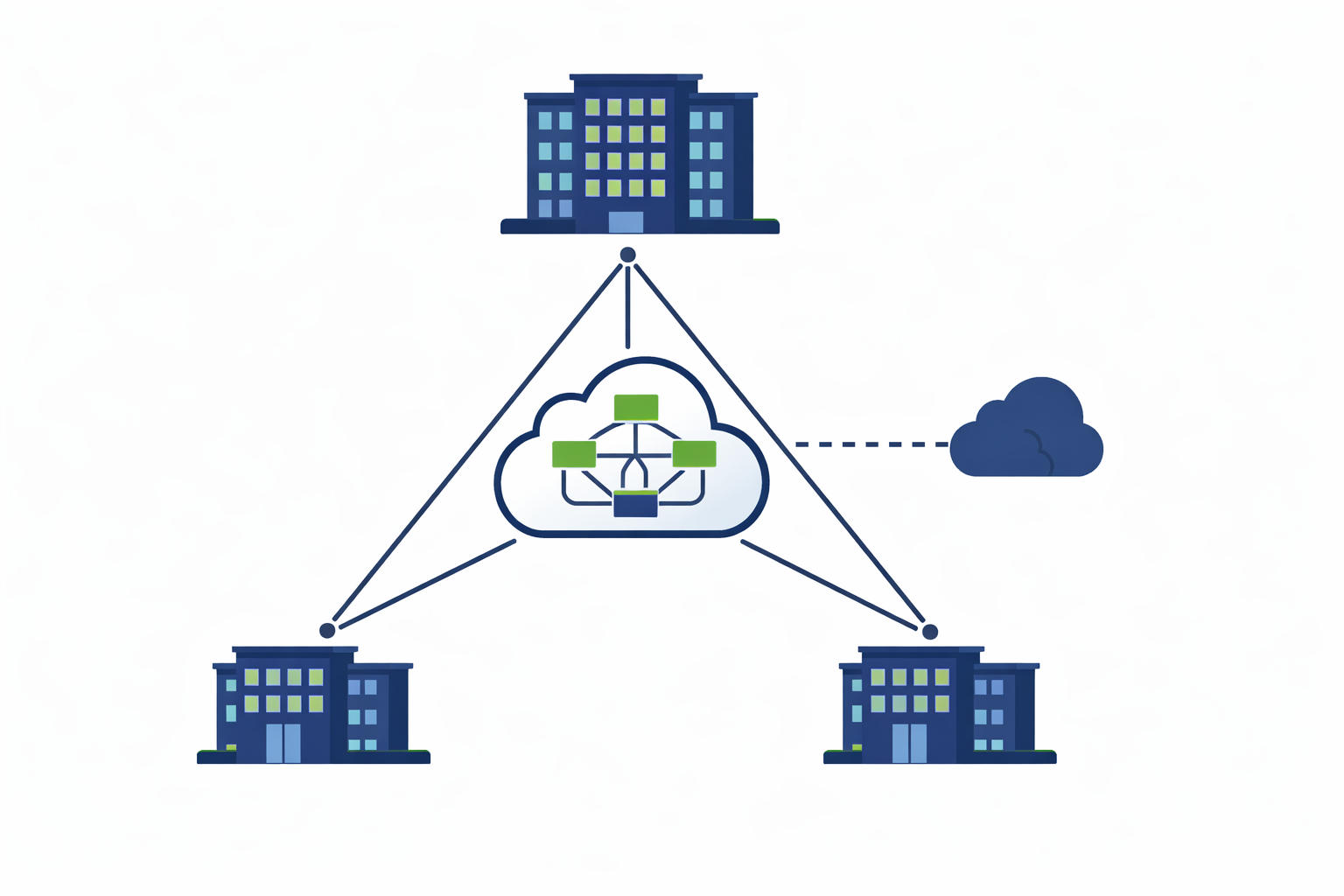
SD-WAN vs Traditional WAN: Where Each One Wins
- Multi-site organizations with cloud-heavy workloads. If your users at branch offices are spending most of their day in Microsoft 365, Salesforce, or cloud ERP, routing that traffic through a central hub over MPLS before it hits the internet creates unnecessary latency and wastes expensive bandwidth. SD-WAN with local internet breakout sends cloud traffic directly from each branch — dramatically improving application performance.
- Cost reduction for distributed networks. Replacing expensive MPLS circuits with broadband — or supplementing MPLS with broadband as a secondary path — can significantly reduce monthly WAN spend. For organizations with 10, 20, or 50+ locations, the savings are substantial. The SD-WAN overlay provides the reliability and traffic intelligence that raw broadband alone can’t.
- Faster branch deployment and scaling. SD-WAN over broadband can be deployed at a new location in days versus weeks for MPLS provisioning. For retail rollouts, franchise expansions, or temporary sites, that speed matters.
- WAN resilience and automatic failover. SD-WAN with dual links — even two broadband connections from different providers — gives you automatic failover invisible to end users. For Southern California organizations dealing with fiber cuts or outages, active-active WAN is a meaningful operational improvement.
- Centralized visibility and management. SD-WAN platforms give network teams application-level visibility across every site from a single dashboard — what’s consuming bandwidth at each branch, how each link is performing, and where problems are developing — without logging into individual devices at each location.
Where Traditional WAN Still Holds Up
SD-WAN isn’t universally superior. There are scenarios where traditional approaches remain the right answer.
- Single-location organizations. If your organization operates from one site, SD-WAN’s core value proposition — intelligently managing traffic across distributed locations — largely doesn’t apply.
- Strict latency and jitter requirements. Some applications — certain real-time trading systems, specialized industrial control environments, and some legacy unified communications deployments — have latency and jitter requirements that managed MPLS handles better than internet-based transport.
- Heavily regulated environments with data residency requirements. Some compliance frameworks have specific requirements about where data travels. In those cases, the private nature of MPLS circuits offers assurances that internet-based SD-WAN transport may not. Evaluate your compliance requirements carefully before moving away from private circuits entirely.

SD-WAN and Security: Not an Afterthought
One thing that gets glossed over in SD-WAN discussions is security. Traditional hub-and-spoke WAN architectures are relatively simple to secure — all traffic goes through headquarters, and security is enforced centrally. SD-WAN with local internet breakout at every branch changes that equation.
Each branch with direct internet access is also a potential attack surface. Secure SD-WAN architectures address this through next-generation firewalls at each branch, DNS-layer security, zero-trust network access policies, and cloud-delivered security services (SASE).
This isn’t a reason to avoid SD-WAN — it’s a reason to deploy it correctly. The organizations that get burned are those that deploy the transport layer without thinking through the security architecture. WCC designs network infrastructure with security built in from day one.
What SD-WAN Deployment Actually Looks Like
A properly deployed SD-WAN project for a Southern California organization typically follows this sequence:
- Site assessment and application analysis. Understanding what applications your users depend on, their performance requirements, and how current WAN performance is affecting productivity at each location.
- Transport selection. Determining the right combination of circuits at each site — MPLS where still justified, broadband from one or two providers, or 4G/5G as backup or primary for smaller locations. This often integrates with your existing wireless network planning.
- Security architecture. Defining how internet-bound traffic is secured at each branch, how zero-trust access policies are enforced, and how SD-WAN integrates with your existing security stack.
- Platform selection. Cisco Meraki SD-WAN is common in SMB and mid-market environments. Palo Alto Prisma SD-WAN and Fortinet Secure SD-WAN are strong choices for organizations with more complex security requirements.
- Phased deployment and testing. A thoughtful migration starts with pilot sites, validates performance against established baselines, and rolls out systematically — with a clear rollback path if something doesn’t work as expected.
SD-WAN or stick with traditional WAN?
✓ Stick with traditional WAN if…
- You operate from a single location
- You have latency-sensitive legacy apps
- Data residency compliance requires private circuits
- Your cloud workloads are minimal
✓ Move to SD-WAN if…
- You have 3+ locations to connect
- Most traffic is cloud (M365, Salesforce, ERP)
- You want to reduce WAN spend
- You need faster branch deployment
- WAN resilience and failover are priorities
The Bottom Line for Southern California IT Teams
The SD-WAN vs traditional WAN decision isn’t one-size-fits-all for Southern California organizations. If you’re managing a multi-site network and a meaningful portion of your traffic is destined for cloud applications, SD-WAN deserves serious consideration. The cost savings on WAN transport are real, the application performance improvements for cloud workloads are real, and the operational visibility gains are real.
If you’re a single-site organization or running applications with specialized performance requirements, evaluate carefully before committing — the benefits may not justify the complexity.
The wrong question is “SD-WAN or traditional WAN?” The right question is: “What does my specific network need to support my specific applications — and what’s the most cost-effective architecture to deliver that?”
WCC Technologies Group designs and deploys SD-WAN and network infrastructure for multi-site organizations across Southern California. If you’re evaluating your WAN architecture and want an honest assessment, talk to one of our engineers.
Frequently Asked Questions
How much can SD-WAN reduce WAN costs for a multi-site organization?
Replacing dedicated MPLS circuits with broadband internet plus an SD-WAN overlay typically reduces WAN transport costs by 30–60% for organizations with multiple locations. The savings are largest for organizations currently paying for high-bandwidth MPLS at many sites. SD-WAN also reduces operational costs through centralized management and faster branch provisioning.
Is SD-WAN secure enough for healthcare or government organizations?
Yes, when deployed correctly. SD-WAN for regulated industries requires a thoughtful security architecture — next-generation firewalls at each branch, encrypted tunnels between sites, DNS-layer filtering, and zero-trust network access policies. Many SD-WAN platforms now integrate security natively (Secure SD-WAN or SASE). The key is ensuring security is designed in from the start, not added as an afterthought.
What SD-WAN platforms does WCC Technologies Group deploy?
WCC designs and deploys SD-WAN solutions from Cisco Meraki, Palo Alto Prisma SD-WAN, and Fortinet Secure SD-WAN. Platform selection depends on your existing infrastructure, team capabilities, security requirements, and vendor relationships. We recommend the right platform for your environment — not the one with the best margin.
How long does an SD-WAN deployment take?
A pilot deployment covering 1–3 sites typically takes 2–4 weeks from design through cutover. A full multi-site rollout depends on the number of locations and complexity of the security architecture. WCC uses a phased approach — pilot sites first, validate performance, then roll out systematically. Most organizations complete full deployments in 4–12 weeks.
Ready to evaluate your WAN?
Talk to a Network Engineer
We’ll assess your current architecture and give you an honest recommendation — SD-WAN or otherwise.