
Brivo for Multi-Site & Multi-Tenant Buildings: A Buyer's Guide
If you operate commercial real estate, manage multiple buildings, or run a multi-site organization where access control is the primary security need, Brivo is almost certainly on your shortlist — and for good reason. Brivo invented the cloud access control category two decades ago and has spent that entire time building the deepest feature set for multi-site and multi-tenant facilities of any platform on the market.
This guide explains what Brivo actually does, where it leads the market, where it doesn't, and how to evaluate whether it's the right platform for your buildings. Vendor-neutral framing, no rankings, no scoring — just an honest look at the platform from an integrator who installs it across Southern California every week.
Brivo is the deepest cloud access control platform for multi-tenant commercial real estate, multi-site retail and franchise operators, multifamily residential, and large distributed enterprises. It's an open platform that integrates with most readers, video systems, identity providers, and property management software — which makes it strong for organizations that want flexibility. The 2025 acquisition of Eagle Eye Networks means Brivo now offers unified cloud video alongside access control under the new Brivo Security Suite. The platform isn't perfect — internet dependency is real, and some recent UI changes have frustrated existing customers — but for the use cases it's designed for, nothing else comes close.
Why Brivo dominates multi-site and multi-tenant access control
Brivo's identity isn't "another cloud access control vendor." It's the platform that created the category and remains specifically architected for organizations that operate multiple buildings or serve multiple tenants. The numbers tell that story.
Translation: when a commercial real estate firm with 30 buildings or a retail franchise with 200 locations shops cloud access control, Brivo is rarely not on the shortlist. The platform was built for them from the start, while many competitors are still adapting single-building products to multi-site reality.
What Brivo actually does (and what's new in 2026)
Until recently, Brivo's identity was clear: cloud access control specialist with deep multi-tenant features, integrated with everyone else for video, visitor management, and other functions. That changed in early 2025 when Brivo acquired Eagle Eye Networks — making them a unified cloud security platform that now combines access control and video natively.
The current Brivo platform — branded Brivo Security Suite — covers six capability areas:
Cloud Access Control
The original Brivo product — cloud-managed door access for offices, multi-tenant buildings, multifamily, and multi-site operators. Mobile credentials, schedules, audit logs, integrations.
Video Surveillance
Eagle Eye-powered cloud VMS now integrated natively. Live monitoring, cloud recording, AI video analytics through the new Eeva agent.
Visitor Management
Visitor pre-registration, self-service kiosk check-in, badge printing, and host notifications — integrated with access control for automated temporary credentials.
Identity Management
Native integration with Active Directory, Azure AD, Okta, and major HR systems. Auto-provisioning and de-provisioning of credentials based on employee status.
Intrusion Detection
Unified intrusion alarm management within the same platform — combining traditional alarm panel functionality with cloud notifications and remote arming.
Smart Home / Multifamily
Resident-facing access for multifamily residential — mobile credentials for unit doors, common areas, amenities. Integrates with property management systems like Entrata.
The 2026 platform has also added two notable features worth understanding:
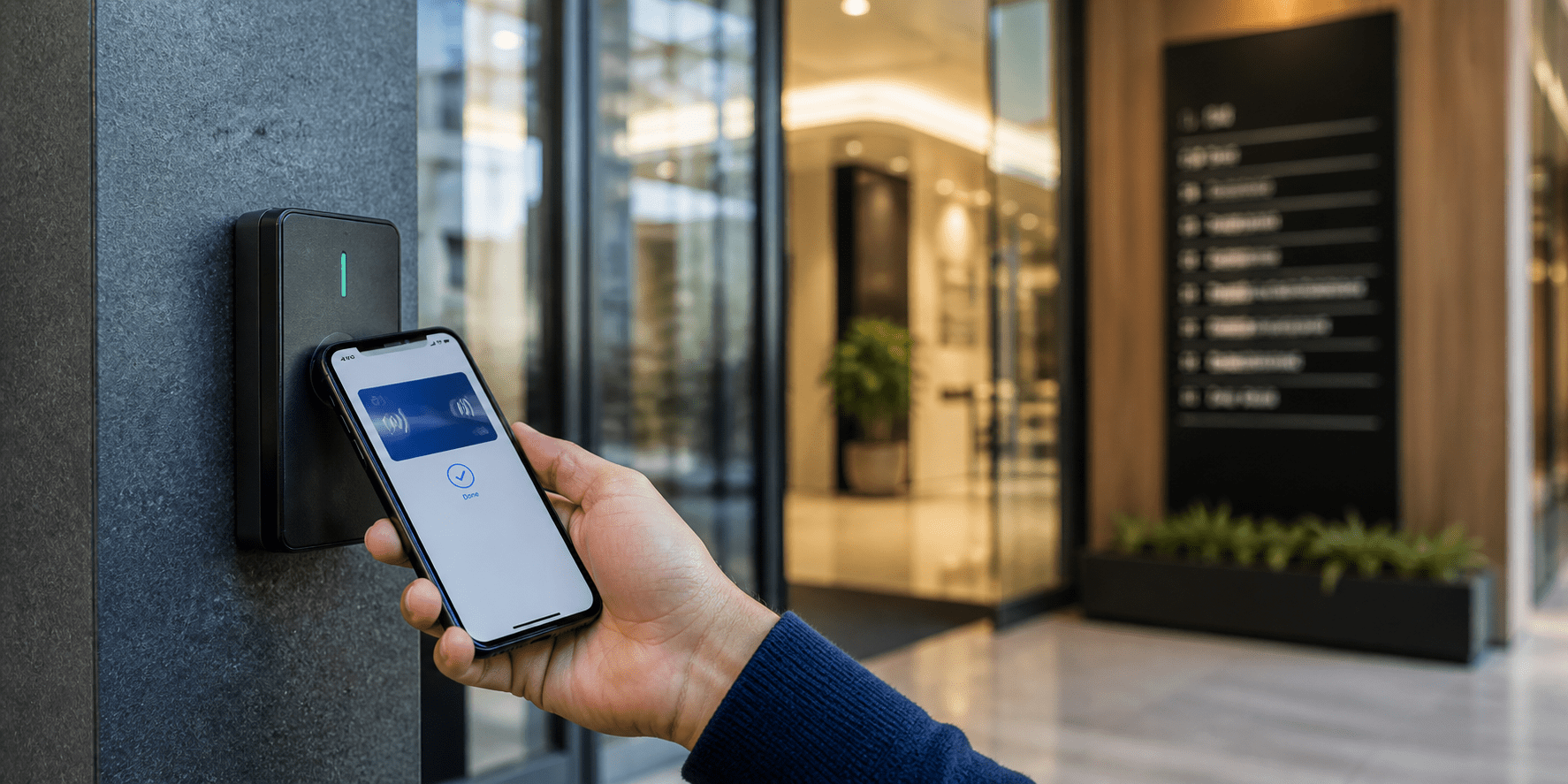
Apple Wallet and Google Wallet credentials. Employees can now store Brivo credentials directly in the wallet apps already on their phones — no separate Brivo app required, no need to unlock the phone before tapping. This is meaningful operationally because it removes one of the most common end-user friction points with mobile credentials. For multifamily and CRE buildings with thousands of users, eliminating "I can't get the app to open" tickets is a real operational win.
Eeva AI video agent. Built into the Eagle Eye-integrated video platform, Eeva lets administrators describe what they want detected in plain language — "someone propping open the loading dock door" or "after-hours activity in the lobby" — and the system monitors the camera feeds for that specific situation. Uses existing cameras. For multi-site operators who can't realistically have someone watching 50+ cameras across 20 sites, AI-assisted detection is a force multiplier.
Five capabilities where Brivo genuinely leads the market
Multi-tenant building management
This is Brivo's home turf. Building owners can grant tenants their own portal — each tenant manages their own employees, schedules, and credentials within the spaces they lease, while the building owner retains master control over common areas, after-hours access, and tenant boundaries. Other platforms can do this. Brivo does it without the workarounds.
Open API and ecosystem integrations
Brivo's open API and partner ecosystem mean it integrates with hundreds of third-party platforms — property management software, HR systems, video platforms, identity providers, and building automation systems. For organizations with existing software they're not replacing, this matters more than feature parity. Brivo plugs into your stack rather than asking your stack to plug into it.
Portfolio-level visibility
The Brivo dashboard shows a single view of all buildings, all sites, all credentials, all events across an entire portfolio. For a property management company with 50 buildings or a retail chain with 200 locations, this is the operational difference between a manageable system and an unmanageable one. Most competitors handle one site beautifully and many sites awkwardly.
Multifamily residential workflows
Brivo has invested heavily in multifamily-specific features that other access control platforms haven't matched: resident self-service portals, integration with leasing and property management software, package room and amenity management, vacancy-to-occupancy automation, and visitor management for residential guests. If you operate multifamily, the operational depth here is unique.
Hardware-agnostic flexibility
Brivo works with a wider range of access control hardware than most cloud platforms — different reader brands, different door types, both new and existing infrastructure. This is the opposite of a vertically integrated approach. The tradeoff is more vendor coordination during installation, but the benefit is preserving existing hardware investment and avoiding vendor lock-in.
Where Brivo falls short — honestly
Every platform has tradeoffs. Pretending otherwise insults the buyer. Here's what we see customers struggle with on Brivo:
Internet dependency for management. Like all cloud access control, Brivo needs internet for administrative changes. Door operation continues during outages because credentials cache locally — but adding users, changing permissions, or pulling reports during an outage doesn't work. For most organizations this is fine. For sites with chronically unreliable internet, it's worth planning around.
UI changes have frustrated existing customers. Brivo Access (the new platform UI introduced over the past few years) has received mixed feedback from long-time customers. Some workflows that were simple in the older interface require more clicks or different navigation in the new one. New customers won't notice — they're learning the current UI fresh — but customers migrating from older Brivo deployments have a real adjustment.
Less polished than competitors in single-site scenarios. If you have a single building with simple access control needs, Brivo's depth in multi-site and multi-tenant features is overhead you're paying for but not using. Verkada or Rhombus may feel cleaner for single-site small deployments. Brivo earns its position when the deployment gets complex.
Hardware coordination during installation. The flexibility of working with multiple hardware brands means deployments often involve more vendor coordination than fully integrated platforms like Verkada. A good integrator handles this transparently. A bad integrator turns it into your problem. Choose carefully.
Three buyer profiles where Brivo wins decisively
Commercial real estate
- You own or manage multi-tenant office buildings
- Tenants need to manage their own access without compromising your master control
- You need portfolio-level visibility across multiple properties
- Tenant satisfaction and retention matter as much as security
- Integration with property management software is required
Retail / franchise / distributed enterprise
- You operate 5+ sites across geographic regions
- Centralized control with local autonomy is required
- Standardization across sites with rapid deployment of new locations
- Identity provider integration drives credential lifecycle
- Reporting across the entire portfolio matters for operations
Apartment / condo communities
- Resident-facing mobile access is a competitive differentiator
- Property management software integration is a hard requirement
- Common areas, amenities, and unit doors all on one platform
- Visitor and delivery access workflows need to be self-service
- Vacancy-to-occupancy turnover automation reduces operational cost
If your organization fits one of these profiles, Brivo deserves to be your default consideration. If it doesn't, Brivo can still work, but other platforms may be a better fit — see our comparison of Verkada, Rhombus, and Brivo for the broader decision framework.
How Brivo is actually purchased and deployed
Brivo isn't sold direct to customers. The platform is delivered through a channel of authorized integrators who design, install, configure, and support deployments. The procurement model has three components:
Hardware — door controllers, readers, panels, and any video equipment if including the Eagle Eye-integrated video. Hardware is a one-time capital purchase, often eligible for financing or lease structures depending on the integrator and the project size.
Software subscription — per-door per-month for access control, with separate per-camera fees if including video. The subscription includes platform access, software updates, support, and cloud infrastructure. Subscriptions are typically annual or multi-year with corresponding pricing.
Professional services — design, installation, configuration, integration with existing systems, user training, and ongoing administration support. This is where the integrator relationship matters most. A good integrator handles design discovery, scope definition, phased deployment, and operational handoff with discipline. A bad integrator improvises.
For organizations migrating from legacy access control to Brivo, our migration planning guide walks through the four-phase process that keeps these projects on schedule. For organizations weighing cloud against staying on-premise, our cloud vs on-prem decision framework covers the architectural decision before the platform decision.
What we see in Southern California
Across our Brivo deployments throughout Los Angeles, Orange County, the Inland Empire, and San Diego, the customer profile is consistent.
Property management firms running 10-50 commercial office buildings choose Brivo because nothing else handles tenant management at that scale without workarounds. The portfolio dashboard view alone often justifies the platform decision.
Retail and franchise operators with 20-100+ Southern California locations standardize on Brivo for the deployment speed and centralized identity management. Adding a new location is a matter of installing hardware and registering it to the existing tenant — not a new IT project at every site.
Multifamily property owners and developers increasingly default to Brivo for new construction because resident-facing mobile access has become a feature renters expect, and Brivo's depth in multifamily-specific workflows is unmatched.
Hybrid Brivo customers — organizations using Brivo for access alongside a separate video platform — have generally consolidated to Brivo Security Suite since the Eagle Eye integration matured. Running one platform instead of two reduces operational complexity that adds up across multiple sites.
Frequently asked questions
Is Brivo just for commercial real estate?
No. While Brivo is best known for commercial real estate and multifamily residential, the platform serves many vertical markets including healthcare, education, manufacturing, retail, financial services, and religious institutions. The common thread isn't the vertical — it's organizational structure. Brivo wins when there are multiple buildings, multiple sites, or multiple tenants involved. A single small office can use Brivo, but the platform's depth shines as the organization gets more distributed.
How does the Brivo and Eagle Eye Networks merger affect customers?
Brivo acquired Eagle Eye Networks at the end of 2025, creating a unified cloud security platform that now combines access control and video natively under Brivo Security Suite. For new customers, this means access and video can be deployed together as one platform with a single management console. For existing Brivo customers using third-party video platforms, current integrations continue to work — but Brivo Security Suite is increasingly the default recommendation for new deployments because the unified experience is operationally simpler than running two separate platforms.
How much does Brivo cost?
Brivo is quoted based on door count, hardware specification, integration scope, video components if included, and the labor required for installation. Pricing varies significantly by project, and published numbers from any source are likely to be misleading. The procurement structure is hardware (one-time) plus per-door subscription (recurring) plus professional services (one-time). An integrator who has walked your facility and understood your scope is the only reliable cost answer.
Can Brivo work with existing access control hardware?
Often, yes — Brivo is more hardware-flexible than most cloud platforms. Standard Wiegand readers, OSDP readers, and many existing door controllers can be retained and connected to Brivo's cloud platform. The discovery phase of any project should determine specifically what existing hardware can be reused, what needs to be replaced, and what additional infrastructure is required. Assumptions about hardware compatibility made before a site walkthrough often turn out to be wrong in either direction.
Does Brivo work during internet outages?
Yes, for door operation. Brivo controllers cache credentials locally, so existing users continue to be granted or denied access during an internet outage. What's lost during an outage is administrative access to the cloud platform — adding users, changing schedules, viewing live activity. When connectivity returns, the controller syncs back automatically. For most organizations this offline behavior is more than acceptable. For facilities with chronically unreliable internet, it's worth flagging during deployment planning.
Is Brivo HIPAA compliant?
Brivo supports HIPAA compliance through Business Associate Agreements and appropriate technical safeguards. The platform itself being capable is necessary but not sufficient — the specific deployment configuration, user management practices, and integration with other systems also need to be HIPAA-aligned. Healthcare organizations should verify BAA terms with Brivo and have their compliance team review the deployment architecture during the design phase.
What identity providers does Brivo integrate with?
Brivo offers native integration with Active Directory, Azure AD, Okta, and major HR systems. Integration enables auto-provisioning and de-provisioning of credentials based on employee onboarding and offboarding events, which is operationally significant for organizations with regular hiring turnover. The integration depth varies by provider — confirming specific requirements with the integrator during scoping prevents surprises later.
How long does a Brivo deployment take?
Cloud access control deployments are dramatically faster than legacy on-premise systems regardless of platform choice. Timeline depends primarily on door count, site count, integration complexity, and operational windows rather than platform-specific factors. Single buildings with a few dozen doors can deploy in weeks; multi-site rollouts with hundreds of doors across many locations require phased planning over months. The right framing is to think in deployment phases — discovery, pilot, rollout, completion — rather than committing to a calendar date upfront.
Considering Brivo for your buildings or portfolio?
WCC is an authorized Brivo integrator across Southern California — designing and installing Brivo Security Suite for commercial real estate, multifamily residential, multi-site retail, and large distributed enterprises. We'll walk your facilities, understand your operational requirements, and design a deployment that scales with your portfolio.
Talk to an Engineer