
When to Replace Copper with Fiber:
A Guide for Southern California Facilities
- Why copper isn't going away — and where it still belongs
- The specific limitations that make copper to fiber upgrades necessary
- Seven scenarios that clearly warrant a fiber upgrade in Southern California
- Multimode vs. single-mode — which fiber type and when
- What a fiber backbone project actually looks like
Making the switch from copper to fiber is one of the most common infrastructure questions Southern California facilities managers face — and one of the most misunderstood. The answer isn't "always upgrade to fiber" or "copper is fine forever." It depends entirely on where you are in your network, how far your runs go, and what you're asking your infrastructure to carry.
This guide breaks down exactly when the copper to fiber upgrade is warranted for Southern California facilities, when copper still has life left, and how to think through the decision without oversimplifying it.
First: Copper Isn't Going Away
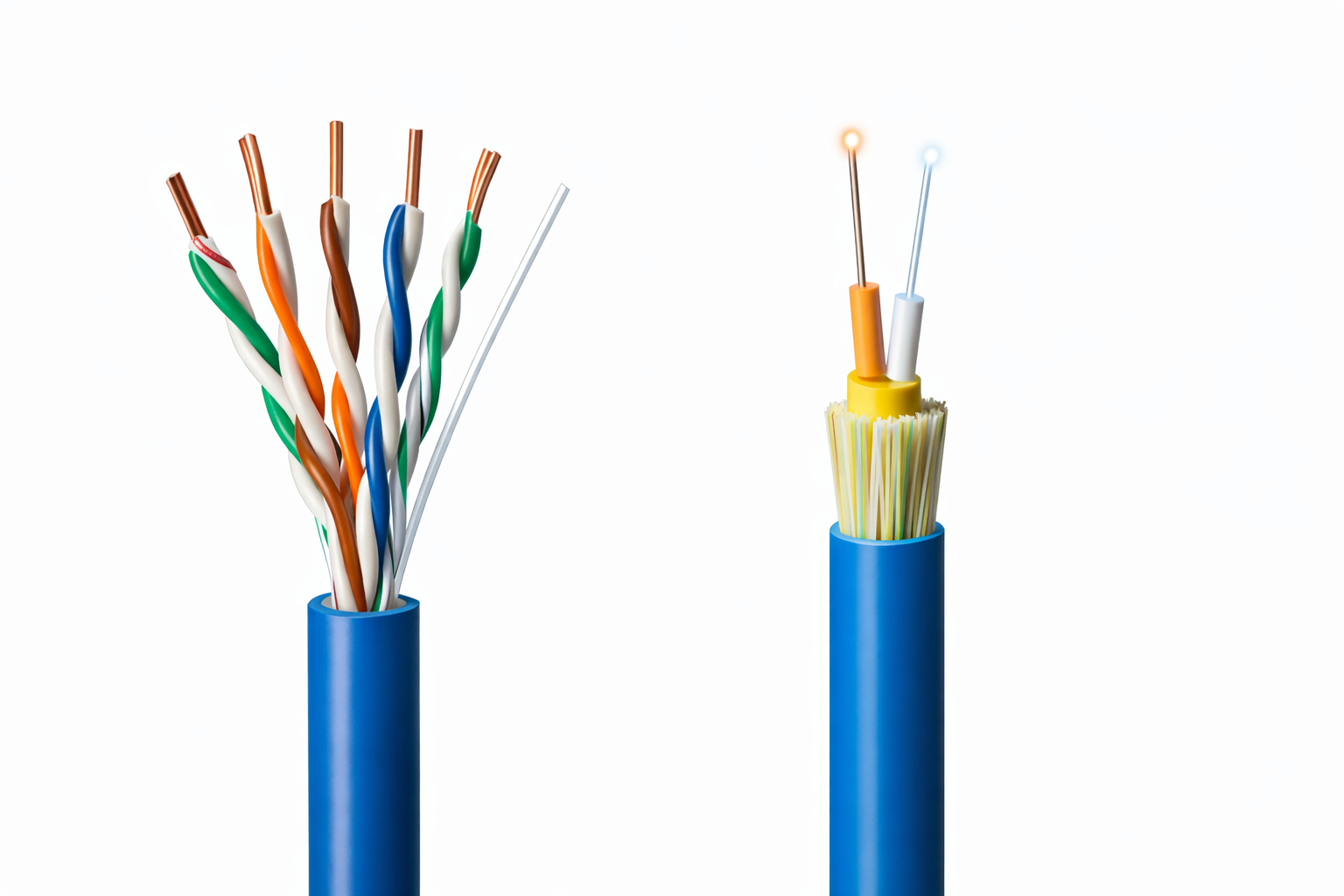
Fiber doesn't replace copper everywhere — they serve different parts of the network for different reasons, and a well-designed infrastructure almost always uses both. Copper — specifically Cat6 and Cat6A — is the right medium for horizontal runs from the IDF to the end device: the workstation, the access point, the IP camera, the access control reader. It's cost-effective, PoE-capable (which fiber is not without additional hardware), and capable for the bandwidth these devices need.
Fiber is the right medium for backbone runs — the connections between your MDFs and IDFs, between buildings, and for high-bandwidth uplinks where copper's distance and speed limitations become real constraints.
The right question isn't "should we replace all our copper with fiber?" It's "where in our infrastructure should fiber be, and does what we have today still support what we're trying to do?"
The Limitations That Drive the Copper to Fiber Conversation
Understanding when the copper to fiber upgrade makes sense for Southern California facilities starts with understanding what copper's limits actually are.
| Limitation | Copper (Cat6A) | Fiber |
|---|---|---|
| Max distance at 10G | 100 meters | 300m+ (multimode) / Several km (single-mode) |
| Max bandwidth | 10 Gbps | 40G, 100G, 400G+ |
| EMI susceptibility | Yes — affected by motors, generators, imaging equipment | None — immune to EMI |
| PoE capability | Yes — native | No — requires additional hardware |
| Between-building runs | Not suitable | Standard approach (OSP fiber) |
| Weight & conduit space | Heavy, larger diameter | Lightweight, small diameter |
| Cost per run | Lower material cost | Higher material, comparable labor |
7 Situations That Warrant a Copper to Fiber Upgrade in Southern California
- Your backbone runs exceed 100 meters. This is the clearest trigger. If you have copper backbone runs between your MDF and IDFs that exceed 100 meters, you may already be outside the reliable operating range for 10 Gbps copper. Fiber resolves this definitively — multimode supports 10G over 300+ meters, single-mode over several kilometers.
- You're upgrading to 10G switching infrastructure. If your core switching is moving to 10G, 25G, or 40G uplinks, you need a backbone that can carry that traffic. Copper backbones can't support the speeds modern switching infrastructure is designed to deliver over typical backbone distances. Learn more about how this affects your network infrastructure planning.
- You have multiple buildings on a single campus. Any outdoor or between-building run needs to be fiber. Copper can't span the distances involved, and outdoor copper installations present grounding and lightning protection challenges that fiber avoids entirely. Outside plant (OSP) fiber is the standard approach for campus-wide connectivity.
- Your current infrastructure is pre-Cat6. If you're running Cat5e backbone or older, you're already constrained at 1 Gbps — a bottleneck the moment you put modern switching infrastructure behind it. A fiber backbone upgrade combined with a copper horizontal refresh gives you a clean, future-ready foundation.
- You're in a high-EMI environment. Manufacturing plants, distribution centers with heavy conveyor systems, healthcare facilities with imaging equipment, and facilities with large HVAC or electrical infrastructure are all candidates for fiber in any run where EMI is a documented or suspected issue. Fiber is completely immune to electromagnetic interference.
- You're doing new construction or a major tenant improvement. When pathways are open and walls are accessible, the cost difference between pulling fiber and copper backbone is relatively small. Building fiber into a new construction project costs far less than retrofitting it later — spec it from the start if there's any chance you'll need the bandwidth in the next decade.
- You're supporting a high-density Wi-Fi deployment. Wi-Fi 6 and Wi-Fi 6E access points can generate multi-gigabit aggregate throughput. When you have dozens of APs per floor in a high-density environment, the aggregate traffic flowing back to your IDF can exceed what a copper backbone can carry. Fiber backbone with 10G or 25G uplinks handles this cleanly. This is directly related to wireless network infrastructure planning.
Multimode vs. Single-Mode: Which Fiber Type for Southern California Facilities?
Not all fiber is the same, and specifying the right type matters for both performance and long-term cost.
The most common mistake in fiber projects: specifying multimode where single-mode is needed, or under-counting strand count to save money upfront — then paying significantly more when you need to add capacity later. Always pull more strands than you currently need. Fiber is cheap. Labor isn't.
- Multimode fiber (OM3, OM4, OM5) is the standard for campus backbone runs within a building or between buildings at shorter distances (under 300 meters). It uses lower-cost VCSEL-based transceivers and supports 10G, 40G, and 100G at appropriate distances. OM4 is the current standard for most commercial deployments in Southern California.
- Single-mode fiber (OS2) is the right choice for longer distances — between buildings, campus-wide runs, and any application where the fiber span exceeds what multimode can support. It uses laser-based transceivers and supports 10G and beyond over several kilometers. For any outdoor or long-distance run, single-mode is the default specification.
- Pre-terminated fiber (cassette and trunk systems from Corning, Sumitomo, and CommScope) speeds up installation and reduces termination errors in MDF/IDF environments. For structured backbone deployments in commercial buildings, pre-terminated solutions are increasingly the preferred approach.
What a Copper to Fiber Upgrade Project Looks Like
A fiber backbone upgrade or new installation in a Southern California commercial facility typically follows this process:
- Infrastructure assessment. Review existing pathways, conduit capacity, MDF/IDF locations, distance measurements, and current switching infrastructure to determine what fiber types and counts are needed.
- Design and specification. Determine the right fiber type (multimode vs. single-mode), strand count, termination approach, and hardware requirements at each end. Always design for future capacity — not just today's needs.
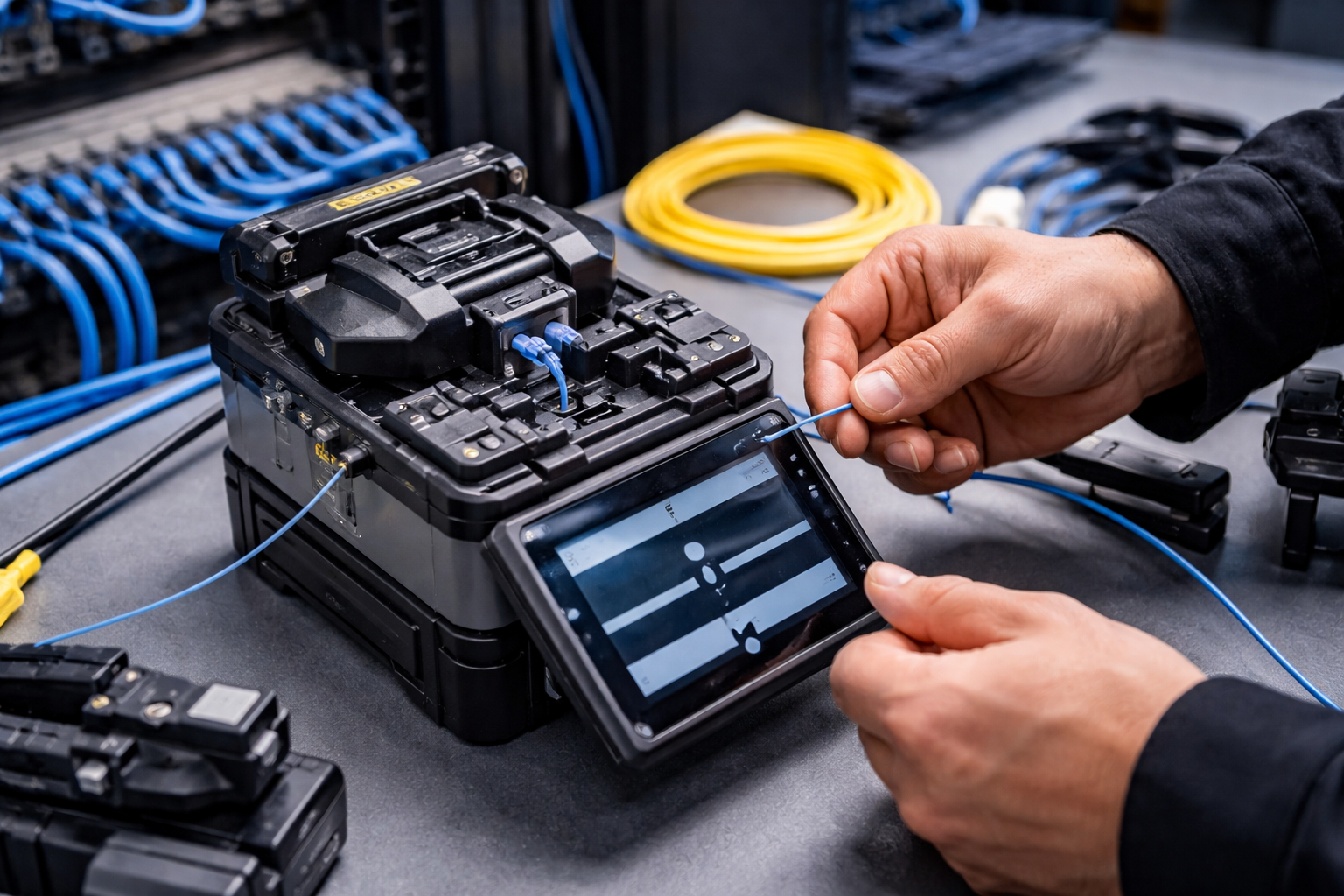
- Installation and testing. Fiber installation requires trained technicians, proper tools, fusion splicing equipment for single-mode runs, and an OTDR (Optical Time Domain Reflectometer) for end-to-end testing and documentation.
- Documentation. Every fiber run should be tested, labeled, and documented with OTDR traces and test reports — for warranty compliance, future troubleshooting, and any future tenant or owner who inherits the infrastructure.
Stay with copper or upgrade to fiber?
✓ Stay with copper if…
- Backbone runs are under 100 meters
- Current infrastructure is Cat6A
- No plans to exceed 10G switching
- Low EMI environment
- Single building, no campus runs
✓ Upgrade to fiber if…
- Backbone runs exceed 100 meters
- Multi-building or campus environment
- Upgrading to 10G+ switching
- High-EMI environment
- New construction or major TI
- High-density Wi-Fi deployment
The Bottom Line on Copper to Fiber for Southern California Facilities
The copper to fiber decision for Southern California facilities comes down to one question: is copper currently a constraint — or will it become one within the lifecycle of your next infrastructure project? If the answer is yes on either count, fiber is the right investment.
The right answer for most facilities is a hybrid architecture: fiber for backbone runs between MDFs and IDFs, between buildings, and anywhere distance or bandwidth makes copper impractical — and Cat6A copper for horizontal runs to end devices. That combination gives you the best performance, PoE capability where you need it, and a backbone that won't need replacing every time you upgrade your switching infrastructure.
Don't replace copper to check a box. Replace it when distance, bandwidth, interference, or upcoming infrastructure upgrades make copper a genuine constraint — and design fiber in from the start whenever walls are open and pathways are accessible.
WCC Technologies Group installs, splices, and certifies single-mode and multimode fiber optic networks across Southern California. If you're evaluating your backbone infrastructure and want a straightforward assessment of what needs to change, talk to one of our engineers.
Frequently Asked Questions
Can fiber replace copper for all cabling in a commercial building?
Technically yes, but it's rarely the right approach. Fiber can't deliver Power over Ethernet (PoE), which means devices like wireless access points, IP cameras, access control readers, and VoIP phones would need separate power sources. For horizontal runs to end devices, copper remains the practical and cost-effective standard. Fiber belongs in the backbone — the runs between MDFs, IDFs, and between buildings — where its distance and bandwidth advantages actually matter.
How much does a fiber backbone upgrade cost in Southern California?
Cost varies significantly based on building size, number of IDF locations, distance between MDFs and IDFs, fiber type, strand count, and termination approach. A single-building fiber backbone for a mid-size commercial facility might range from $15,000 to $60,000 fully installed and certified. Campus environments with multiple buildings and outside plant fiber runs will be higher. WCC provides detailed proposals based on a site assessment — contact us for a site-specific estimate.
What is the difference between multimode and single-mode fiber?
Multimode fiber (OM3, OM4, OM5) is designed for shorter distances — typically up to 300 meters — and uses lower-cost VCSEL-based transceivers. It's the standard for in-building backbone runs. Single-mode fiber (OS2) supports much longer distances — several kilometers — and uses laser-based transceivers that cost more. Single-mode is the standard for between-building, campus-wide, and outside plant runs. For most commercial buildings in Southern California, multimode fiber handles in-building backbone and single-mode handles anything between buildings or across a campus.
How long does fiber optic cabling last?
Properly installed fiber optic cabling has a physical lifespan of 25–30 years or more. Unlike copper, fiber doesn't degrade from electromagnetic interference or corrosion. The limiting factor is typically the transceivers and active equipment at each end, not the fiber itself. A properly designed and installed fiber backbone is essentially a permanent infrastructure investment — the same fiber plant can support 10G today and 100G tomorrow by upgrading the transceivers, without touching the cable.
Ready to evaluate your backbone?
Talk to a Fiber Optic Engineer
We'll assess your current infrastructure and give you a straight answer on what needs to change — and what doesn't.